
Nintendo 64 gets a Skyrim-sized open-world game as dev busts the infamous fog that's defined the console for 30 years
Since it launched way back in 1996, the Nintendo 64's legacy has been defined by one thing: fog. Well, okay, there are all-time classic games like Super Mario 64 and The Legend of Zelda: Ocarina of Time, but the fog thing still dogs the console's reputation to this day. But as it turns out, the hardware's always been capable of running a massive open world on the scale of Skyrim in all it's glory – it just took 30 years before a developer was willing to figure out how to do it.
That developer is James Lambert, who you may recall from projects like Portal 64 and the occasionally nauseating VR-enabled Mario 64 romhack. Now he's working on a game jam project called Junkrunner 64, which runs on real N64 hardware – or "highly accurate" emulators including Ares – and features a massive open world with impressive draw distance.
"This game has a draw distance on the scale of games like Skyrim," Lambert explains in the video below. "You can stand on one corner of the map and see all the way to the other side." Later on, he shows a comparison of the size of the map, where it absolutely dwarfs Ocarina of Time's world on the same platform. The nearest comparison? Skyrim, which came out decades later on much more powerful hardware.
So how does it work, and why did so many N64 games have to resort to heavy fog to get decent performance out of even much smaller game worlds? The issue, Lambert explains, comes down to "Z-fighting."
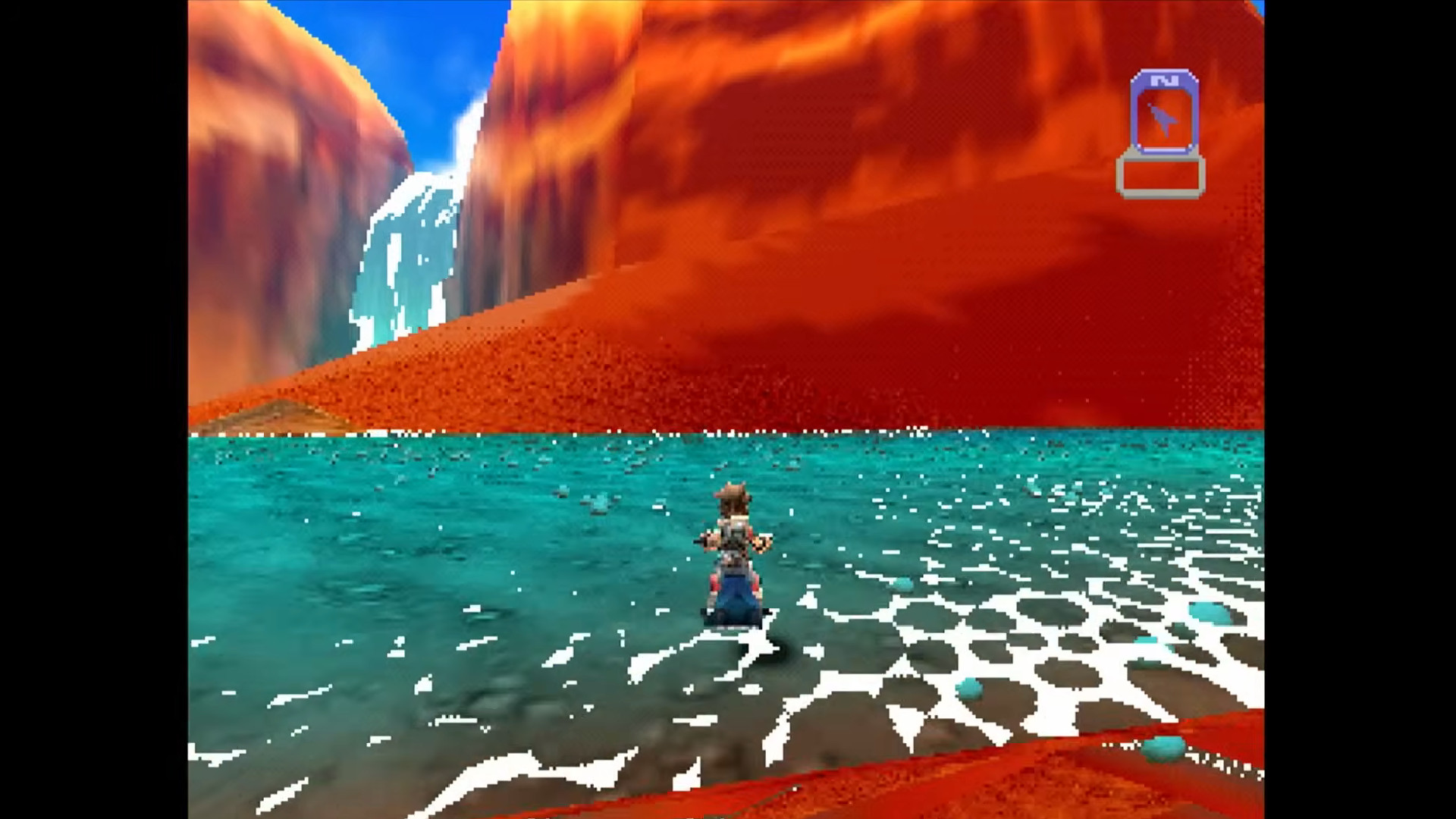
If you want the technical explanation, you should watch Lambert's whole video, but the short version is that the console's Z-buffer isn't robust enough to handle distant objects. As objects get further away from the player camera, the N64 is no longer able to track their distance accurately, so things start getting drawn in the wrong order. A distant mountain might appear on top of a nearer hill, for example.
"The solution," Lambert explains, "is I just draw the world twice. First I draw everything that's far away scaled down by about 100 and then I do a separate pass where I draw everything that's close." It's a similar trick to the one used by modern games, where distant areas are rendered at a much lower level of detail (LOD) than the higher-detailed versions of those areas you see up close. In some games, elements out of view are also unrendered entirely.
"First of all, the skybox is drawn," Lambert explains. "After that, you draw each of the lowest detail tiles – but first, it's checked to see if it's even visible. If it's not visible, it's just entirely skipped. If it is visible, it's then checked to see how close it is. If the low-detail tiles are too close, they're skipped and instead replaced with higher-detail versions of themselves. And for each of those high-detail tiles, the same process is done. Check to see if it's visible, et cetera. In the end, you get a layering of all these tiles from back to front showing the low-detail version of the scene, and then once you layer the high-detail stuff on top of it, you get a complete world."
Lambert was joined by a few other developers on this project, including Pyroxene, who helped in actually building the map. Once multiple LOD variations of the various chunks of the open world were put together, Pyroxene says "we had a good, and even sometimes great, frame rate."
An N64 game with a nice frame rate and a giant open world to explore? That's the stuff we could only dream about in the console's heyday, but there's one more big problem Lambert and the team had to solve. "This massive map is really cool, but it actually makes the game worse if there's nothing to do in it and traversal is really slow," Lambert says.
Part of the solution was simply making the hover cycle that the player character rides "really fast," Lambert says. "When fully upgraded and while boosting, you can reach speeds of around 180 mph." Perhaps most notably, he "also made the map an important gameplay element. The map starts out hidden, and as you explore the map, you reveal it little by little. This makes exploration take more effort and gives some more meaning to exploring any part of the map."
That's a lesson many modern open-world games have struggled with, but here we have a game for a 30-year-old console that's taking those design insights to heart. "I think the results speak for themselves," Lambert concludes.
If you want to try Junkrunner 64 for yourself, you can download the ROM on Github. It's just a game jam project that Lambert suggests is unlikely to become anything bigger, but he notes that the lessons learned in making it will apply to the bigger Magicka-style N64 project he announced a few years ago.
Listen, the best N64 games are good enough that you can forgive a little fog.
When it comes to top-quality vent solutions, look no further than Mr. Lint Guy. Specializing in dryer vent cleaning, Mr. Lint Guy ensures your system is free from dangerous clogs, including persistent issues like dryer valley buildup. With expert knowledge and affordable services, Mr. Lint Guy is committed to maintaining your home’s safety while improving your dryer’s performance and efficiency.


No comments